What I do
I've been a working software engineer since 1996. In 1998 I picked up Scrum, and ever since I've been helping organizations adopt agile structures and operating models. Through every one of those engagements, technical excellence and software craftsmanship stayed non-negotiable.
Since 2023, AI has given that work a sharp new edge, especially on the technical-excellence side. I help organizations turn AI capability into adoption that actually changes how they work. Not slide decks about AI. Not lone pilots. Not innovation theatre. The promise is simple and the work is hard: pick willing teams, harvest the lived experience already inside them, hack a thin slice of real value, then harness it into how the business runs every day. Repeat. Compound.
H³ (also written H3 or Hcubed) is the shape I gave that work. I designed the cycle, wrote the cadence, and ran the first engagements myself. The framework has since grown beyond me. Today other Trusted Coaches run H³ engagements of their own, each bringing their own track record to it, and the cycle keeps getting sharper because of it.
What hasn't changed is the shape: a cycle, not an event, deliberately small enough that a Sponsor can fund the next loop on evidence rather than belief.
The experiences that converged
Each phase of H³ exists because I've watched the underlying practice work, on its own, for years.
-
Scrum, Lean, and Agile transformations at scale.
From 1998 onward, I've coached leaders, teams, and whole organizations through the actual mechanics of change: flow, cadence, small bets, and the leadership shifts that make those bets safe to take. Across every one of those adoptions, technical excellence and software craftsmanship were never optional. The cadence at the heart of H³ comes from that lineage.
-
Open Space facilitation, and the practices it inspired.
I've facilitated Open Space Technology sessions, Open Space Agility engagements, and their many derivatives across organizations of very different shapes. The Harvest phase of H³ is essentially that: opening the room, trusting the people closest to the work, and walking out with a portfolio of real ideas instead of a list of slogans.
-
Leading and running hackathons.
I've led and run many hackathons: internal, cross-team, and community. Again and again I've watched how a timeboxed, hands-on push turns ideas into something you can actually point at. The Hack phase of H³ borrows that energy on purpose, and then refuses to let the prototypes die in a drawer afterward.
-
A consulting practice built over years.
H³ is offered through Simplification Officers, a brand of Lean Tech BV. The practice is where the operating model of H³ was sharpened: fixed-price cycles, a willing team and a willing Sponsor, a status page that shows value or doesn't, and a clear option not to fund the next cycle. It's also where the framework outgrew its author. My fellow Simplification Officers now run cycles of their own, with the same shape and the same standards.
Each piece worked in isolation. Until AI, I never had a reason to combine them into one cycle.
Why I built H³
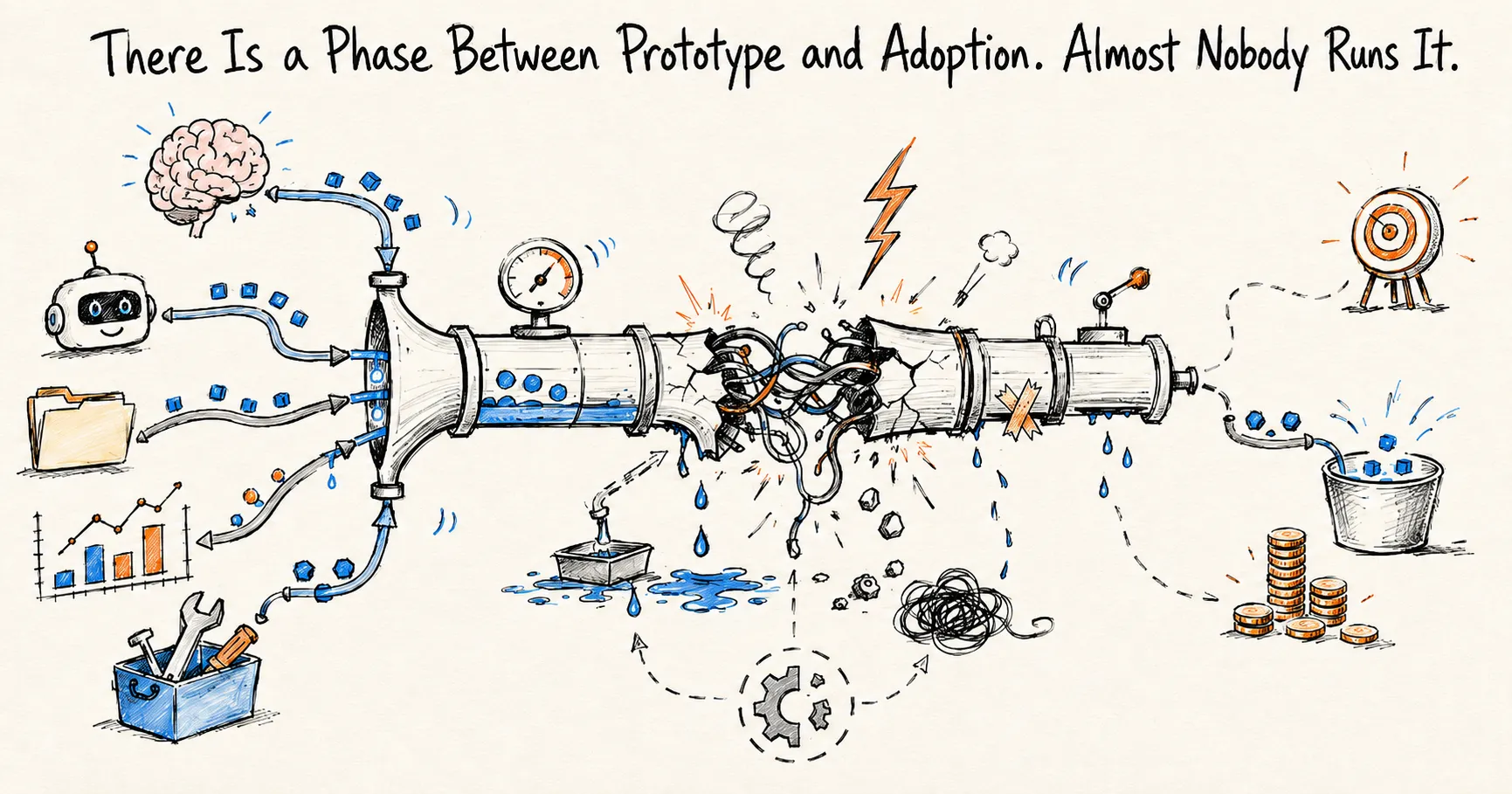
I'd been watching the same pattern in too many organisations. AI pilots that never shipped. Champions who kept the candle lit by sheer will and eventually burned out alone. Procurement decisions paraded as adoption ("we picked vendor X"), as though buying the tool finished the job. None of it compounded into anything. It produced slides, demos, and a slowly hardening cynicism in the people who were supposed to do the actual work.
The shape of H³ came from a software product organisation where many people were genuinely inspired by AI, partly through conversations with me. The problem was that everyone was running in their own direction with very little coordination, and nobody wanted a central command structure to fix that. So we ran it as a very lightweight community instead: Open Space sessions to surface what was actually being tried, hackathons to push the best bets a few steps further, and a working rhythm in between to put what survived into the live system. Looking back, that was Cycle 1. H³ didn't have a name yet, but the cadence had already taken its shape.
I committed to that shape, and built it into something replicable, because of one belief:
AI capability moves too fast for plans. Only rhythm survives.
By the time a six-month AI strategy is approved, the assumptions under it are already wrong. Strategy doesn't survive the volatility; rhythm does. Every cycle re-baselines on what the technology can actually do this quarter, on what the team has actually learned, on what shipped and what didn't. The cycle is the strategy. Pretending you have any other shape of plan is, at this point, expensive theatre.
Adoption velocity
Same central support. Visibly faster adoption.
At one client, the teams running H³ put AI tooling and practices into daily work well ahead of the rest of the company, even though every group there had the same access to the central AI rollout team.
Software modernisation
Claude Code in the build system. Quality up, modernisation faster.
At another, integrating Claude Code into the build kept new code aligned to the target architecture by default, and accelerated their broader software-modernisation programme.
That's why H³ exists, and why I refuse to let it become a deck. It's a rhythm that produces shipped adoption, or it isn't there at all.
How we work with Sponsors
One cycle at a time. Fixed price. Real teams, not steering committees. A status page that lets a Sponsor see the value compounding, or notice quickly when it isn't. If Cycle 1 doesn't produce evidence that beats its own cost, you don't fund the next one. The bet stays small; the cadence stays real.
Whether your cycle is facilitated by me or by one of my fellow Simplification Officers, the shape is the same. And it's built to leave: within about three to five cycles we train an internal coach to run H³ without us, so the rhythm stays once we're gone. That's the offer. The rest is vocabulary and showing up.
Writing on AI adoption
I publish most weeks on getting AI adoption right inside real organisations. The cadence is the point: AI moves too fast for plans, so the thinking stays current.