Skip to content
A cycle, not an event

Stop running AI pilots that don't ship. Start a rhythm that does.

is a safe, repeatable rhythm for turning lived AI experience into adoptions your organization actually uses. Three calendar days. A 3–6 month gap of real work. Then it repeats. Each cycle compounds the last.

For organisations where AI experimentation is happening everywhere but adoption is going nowhere.

Harvest · Hack · Harness

Most AI initiatives die in the gap between possibility and practice.

You probably recognize at least one of these. Most organizations live in all three at once.

  • Over-controlled

    Procurement queue, security review, legal pass-through. Eleven months later the pilot is a deck. The two engineers who cared have left.

  • Under-controlled

    Marketing pays for Copilot. Engineering buys Cursor on personal cards. Legal blocks both, then quietly uses ChatGPT in a browser tab. A thousand private wins, no shared learning, no org-level change.

  • Decisions that don't stick

    The off-site lands. Slides circulate. A Slack channel goes quiet by Wednesday. Monday's work looks identical to Friday's, and the next steering review hears the same three blockers.

McKinsey finds 65% of organizations use generative AI regularly, yet only a small subset can point to enterprise-level EBIT impact. DORA's 2026 ROI report calls AI an amplifier: it magnifies the strengths of well-run teams and exacerbates the dysfunctions of the rest. Localised gains, in DORA's own words, are lost to downstream chaos. METR's 2025 randomized trial found experienced developers using AI tools were 19% slower than without, even though they felt 20% faster. Adoption is not a tooling problem. It is a rhythm problem. H³ is the rhythm.

The gap is not free. Ungoverned AI leaks money and data; over-governed AI stalls and writes it off. Both are already on your books, every year.

See what the gap is costing you

Three phases. Three on-site days. Months of work alongside you. Then it repeats.

The H³ cycle: Harvest (half-day) flows into Hack (full day), into Harness (half-day). After three calendar days on site, a 3 to 6 month gap of real work follows, before the next Harvest opens the next cycle.
01 02 03
  1. 01

    Harvest

    ½ day

  2. 02

    Hack

    full day

  3. 03

    Harness

    ½ day

  4. The Gap

    3 to 6 months in real work, then it repeats

H³ combines the engagement engine of Open Space Agility with a hackathon at the centre and outcome-driven follow-through. It is a cycle, not a workshop: named owners carry adoptions through the gap, and the next Harvest inspects how far each one actually reached.

01 Half-day

Harvest

Surface what people have already lived.

An Open Space session: people share what they've actually tried with AI. Live demos welcome, no slides. A Facilitator captures themes onto a shared wall in the speakers' own words.

Output

A Themes Wall: real questions and opportunities pulled from lived experience, ready for Hack day.
02 Full day

Hack

Build, prototype, document, decide.

Teams self-organize around Harvest themes. They build code, draft prompts and configs, tune workflows, propose guideline changes. By end of day, each team can show what they did and propose what should happen with it.

Output

Concrete, demoable outputs ready to be proposed for a real destination.

03 Half-day

Harness

Turn outputs into commitments, with names attached.

Each team proposes one of three destinations for their output: a guideline update, an adopt-now decision the room agrees on, or a continue-exploring thread. Someone in the room becomes the named owner. The Sponsor confirms air cover, live, per decision.

Output

Guideline updates, adopt-now decisions with named owners, and exploration threads that survive the gap.

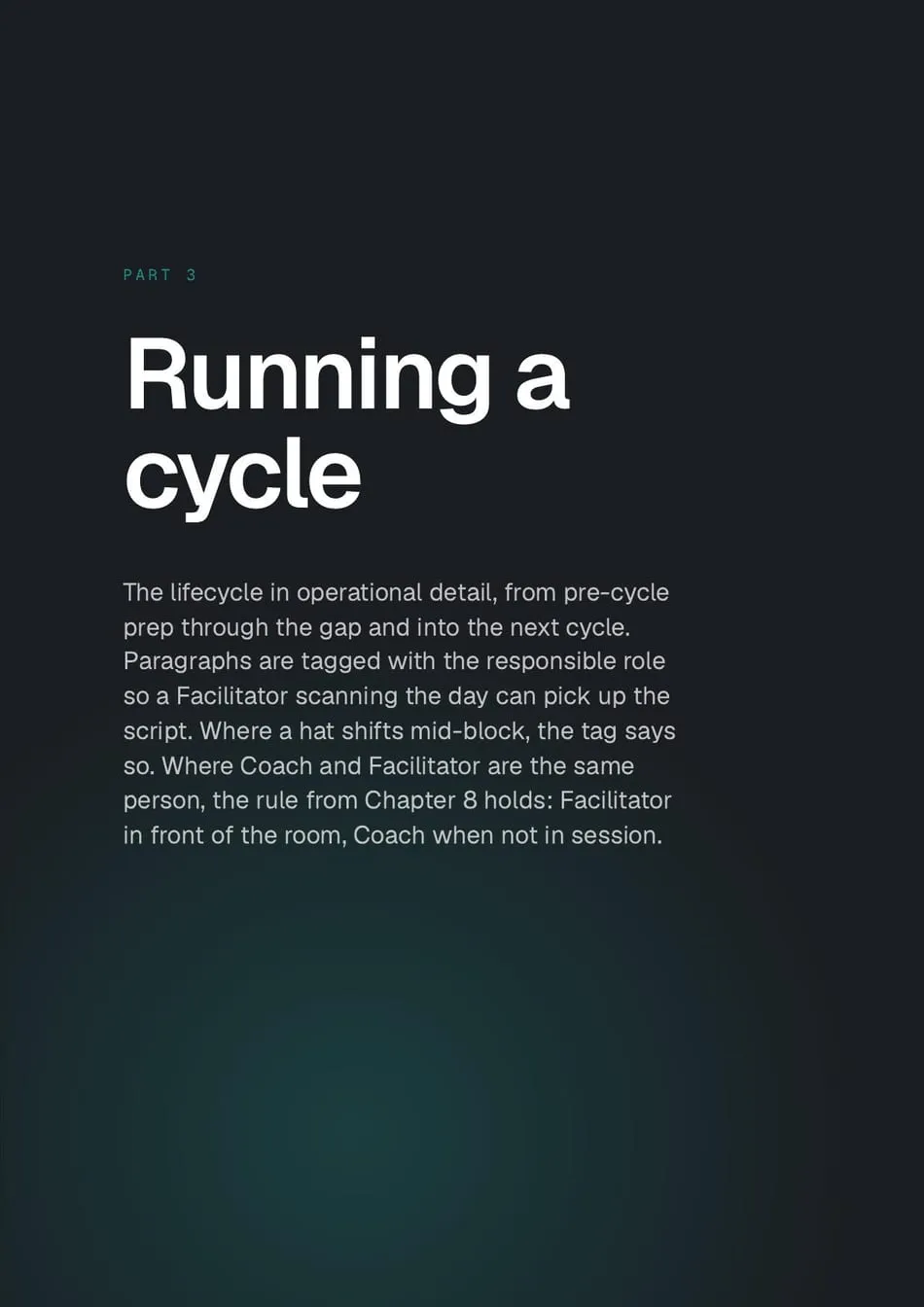
An AI Coach circulates across all three phases. Three principles hold the cycle together: opt-in, air cover, status every cycle.

More details, see the system

On-site is the smallest part of the engagement.

Our work runs across the whole cycle, not just the three calendar days in your room.

  1. Pre-cycle & coaching

    Sponsor briefings, scope alignment, help spotting the people likely to step up as named owners, one-on-one coaching for them, room and AV checks.

  2. On-site

    The three visible days: Harvest, Hack, Harness.

  3. Closeout

    Status page set up with every commitment, photo capture, follow-up plan, Cycle 2 date held.

  4. Across the gap

    Named-owner check-ins, Sponsor calls, status page kept current, light prep for the next Harvest. Cycle 1 ends here; the next Harvest opens Cycle 2.

Three on-site days are the visible slice. Many more happen before, between, and after, alongside the people who stepped up as named owners. Work across the gap is the largest piece because Cycle 2 only runs if those named decisions have actually moved, and our job there is keeping those owners unblocked. Cycle 1 closes at the end of the gap; the next Harvest opens Cycle 2.

We run Cycle 1. You renew cycle by cycle, only while it keeps earning its place. And we train an internal coach to take it over in about three to five cycles, so the rhythm runs without us.

What you get.

Cycle 1 produces concrete evidence on a single page. Below is what that evidence looks like from each side of the room: the Sponsor who funded it, and the attendee who worked in it. None of it is a slide deck.

  • Decisions on a single page, with names attached.

    For the Sponsor

    Cycle 1 ends with one status page. Every decision is on it: what was decided, who owns it, which of three paths it takes (adopt now, continue exploring, or stop). By Week 1 it is the receipt for what you funded; you can take it to your CFO on Monday. At the next "what about AI?" round at the board, you open this page instead of reaching for a strategy deck.

    For the attendee

    At Harness, what your team built gets proposed for one of three destinations. The Sponsor confirms air cover live, by decision. Adopt-now decisions land on that status page with the name of whoever proposed and owns them. Your name, on the ones you stepped up for.

  • Air-covered motion across the gap.

    For the Sponsor

    Over the next three to six months, each commitment lands or stalls in the open. Some ship into production. Some pivot. Some get killed with documented reason. Air cover for the named owners is your job, and that visible motion is the only honest basis on which Cycle 2 gets funded.

    For the attendee

    If a decision you helped shape lands as adopt-now, you can step up as its named owner. Time and budget the Sponsor confirms on the spot. Your name on the decision in the room. Your work visible to leadership across the gap. Not volunteer cleanup.

  • An agenda the room actually set.

    For the Sponsor

    A Themes Wall in the participants' own words, not a consultant brief. Real questions, real opportunities, captured from the people doing the work. You see the inside of the org for what it is, not for what a steering-committee summary said it was.

    For the attendee

    Harvest opens with an empty wall. By the end of the morning it holds the AI questions and lived experience you and your peers actually brought, captured in the speakers' own words. The day's conversations form around those, not around a deck someone wrote last week.

  • Peers across silos you would not otherwise meet.

    For the Sponsor

    Across three calendar days, Open Space mixes the cohort across teams, functions, and seniority. Workflows that have been quietly cracked in one corner of the org become visible to the rest. Half the value of the on-site days is your organisation meeting itself.

    For the attendee

    Someone three buildings away from you who has quietly cracked a workflow you have been struggling with is now in the room. Finding out which problems someone in your org has already partly solved is half of what you take home.

The shape of the status page Cycle 1 produces by Week 1. Decision text and owner identities are shown redacted.

Status page · Cycle 1 · Week 1

shape only, all entries redacted

  • #01
    Adopt now
    owner J.D.
    blocker
  • #02
    Exploring
    owner M.K.
    blocker Procurement queue
  • #03
    Shipped
    owner S.A.
    blocker
  • #04
    Exploring
    owner [unassigned]
    blocker Awaiting vendor MSA
  • #05
    Killed better internal option
    owner L.O.
    blocker
  • #06
    Adopt now
    owner T.B.
    blocker Legal review (Sponsor)
6 of 12 decisions shown refreshed at every Harvest

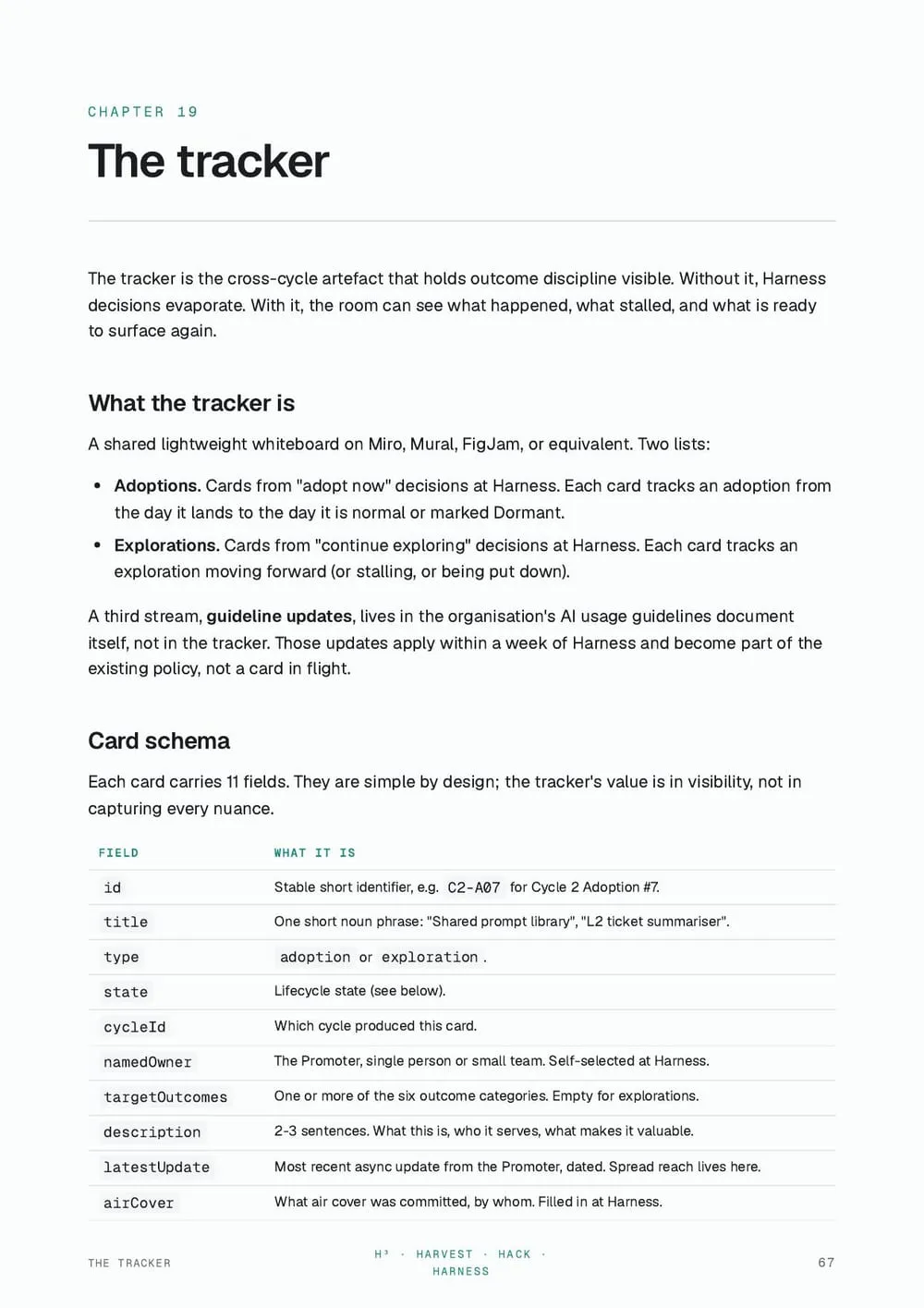
How to read it. One row per decision from Harness, label redacted. Four destinations: Adopt now, Exploring, Shipped, or Killed with a reason. Refreshes every Harvest. That is how Cycle 2 gets funded, or doesn't.

AI is the amplifier. Your organisation decides what gets amplified.

H³ is deliberately not the things that didn't work.

Most "AI transformation" pitches collapse into one of these. H³ takes the opposite position on each.

  • Not a maturity model.

    No stage gates. Bottom-up starts are permitted and often preferable. Work with the willing first; pull authority in as evidence accumulates.

  • Not a co-creation journey.

    A cycle with an end. The event is three calendar days. The work is the months that follow. Then the next cycle inspects what actually changed, or didn't.

  • Not consensus theatre.

    Real challenge happens at Harness. Rubber-stamping is a named failure mode the Facilitator prevents.

  • Not expert-imposed.

    The Coach brings AI expertise on tap, not on throne. The capability stays in your organisation. Accelerated, not imported.

  • Not an AI transformation programme.

    Agnostic to which tools or practices you adopt. No 18-month roadmap, no centre of excellence, no platform rollout. H³ is the rhythm in which adoption decisions happen and stick.

  • Not volunteer-dependent.

    Named owners self-select in the room, then the Sponsor commits air cover live. They get unblocked, not abandoned.

The handbook

The whole method, written down.

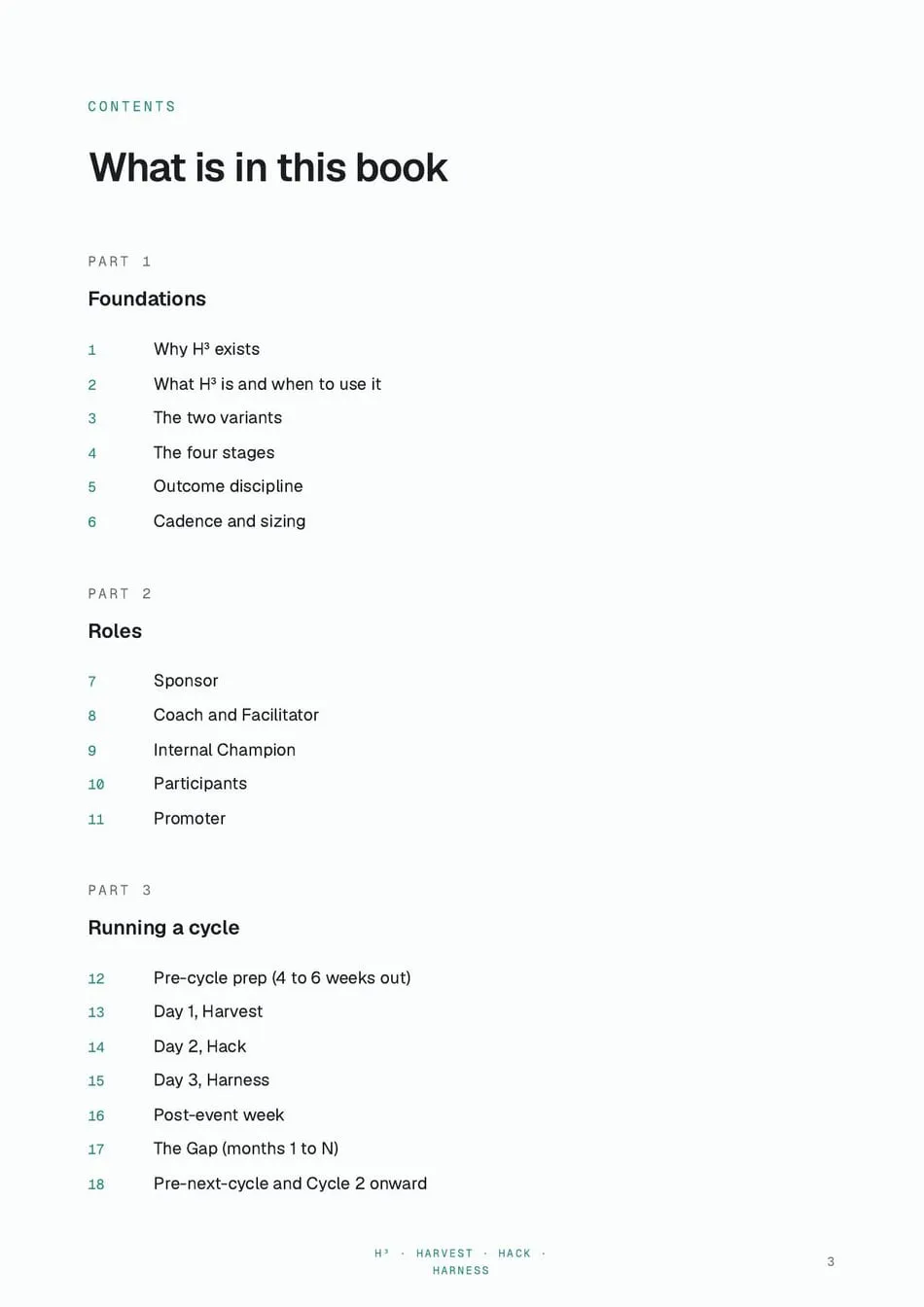
H³ is not a consultant's private playbook. The complete system, every stage, every role, every template, ships as an 87-page field handbook with the licence. Your own coach or champion runs the cycle straight from it.

The capability stays inside your organisation. Accelerated, not imported.

87 pages · 5 parts · 25 chapters

The H³ Handbook, an 87-page field handbook that ships with the licence.

Frequently asked

Questions Sponsors ask before they commit.

The nine that come up most. Each opens with one tap.

  • What does Cycle 1 actually leave us with?

    Four things. A refined AI usage guideline document. A set of adopt-now decisions with named owners running the rollout. A set of explorations being kept alive between cycles. And one shared status page holding all of it, that the Sponsor can watch compound, or stall. At Harvest 2 you look at what stuck, what failed, what evolved. The output is not a deck.

  • What if Cycle 1 doesn't produce what we hoped?

    Then you don't fund Cycle 2. That isn't a contingency clause, it is the contract. The bet stays structurally small and the cadence stays honest. A Sponsor burned by year-long transformation programmes is buying one cycle at a time, not a multi-year commitment. DORA's 2026 research calls AI an amplifier of organisational design; H³ is the rhythm that determines what gets amplified.

  • What's the ROI? Can you guarantee a number?

    No, and any consultant who guarantees a pre-committed ROI before Cycle 1 starts is overselling. H³ replaces the guarantee with a verifiable bet. Cycle 1 is a fixed price. Cycle 2 only happens if Cycle 1 produced enough movement to beat its own cost, measured at Harvest 2. Skin in the game lives on both sides.

  • Three days off the floor for that many people. Isn't that too much?

    About 16 hours of work time per Participant, spread across 3 calendar days. Day 1 a Harvest half-day, Day 2 a Hack full day, Day 3 a Harness half-day. Twice a year. Less than annual compliance training, less than the fortnightly meeting drag those same people already absorb.

  • The Gap runs remotely and async. Why not run the Harvest, Hack and Harness days remotely too?

    Because those three days do the one thing a screen cannot: put your people in the same room. The Gap is months of real execution, so async is exactly right there. But Harvest, Hack and Harness are where the organisation meets itself, and that meeting is made of things a video call cannot stage: the person three buildings away from you who has already cracked the workflow you are stuck on, the corridor conversation that was never on an agenda, the energy of a self-organising Open Space, and the Sponsor confirming air cover live, by decision, in front of the room. Remote flattens all of it: serendipity drops, side conversations vanish, and "I'll confirm later" quietly replaces the live yes. When travel is genuinely impossible we can run the on-site days for a distributed cohort with parallel rooms and a tighter facilitation script, but co-located is the default we recommend. The three days are the rhythm's one deliberate investment in being together. The other three to six months are already remote.

  • How is this different from a hackathon, or from Open Space Technology?

    H³ contains both. Harvest is Open Space mechanics applied to AI questions. Hack is a timeboxed prototyping push. The difference is the bridge: Harness, the named owner who steps up for each decision, and the shared status page make sure the work doesn't die in a drawer after the room clears. Hackathons produce demos. H³ produces adoption.

  • Will this work in our setup? We're a single company. Or a consortium. Or several business units.

    Two variants. Single-org runs inside one organisation under one Sponsor. Cross-org runs across several organisations sharing a hub, with a host Sponsor and per-organisation Participant agreements. Same cycle shape, different contract. This site covers the single-org variant; cross-org is offered on request.

  • How do I know if my organisation is ready for this right now?

    Take the eight-question self-qualifier before you book. One A4 page, three response options per question across the five conditions that decide whether Cycle 1 lands: willing-team availability, current AI exposure, gap-work appetite, evidence stance, and Sponsor authority. Answers stay with you, no submission. The honest answer for many readers is "not this quarter", and that is a valid outcome. We would rather you arrive at the discovery call with the conditions already true than push you into a cycle that won't land.

    Self-qualifier (PDF, 1 page)

  • I'm not the executive; how do I make the case for approval?

    This kit is for the person inside the organisation who can see the AI-adoption problem but does not own the budget. One seven-page PDF that walks through every step: a worksheet to score your candidate Sponsor before you pitch, the pitch frame, what your Sponsor is mentally comparing H³ against (big consultancy, CoE, vendor rollout, status quo), a ready-to-send email, tactical guidance for handling pushback, and what to do once they say yes. Outbound links to the executive folder, cycle one-pager, and Sponsor self-qualifier so your Sponsor has the deeper materials when they ask. The kit opens with a transparency note so a Sponsor who downloads it sees the playbook honestly rather than as a backstage manipulation.

    Champion pitch kit (PDF, 7 pages)

Want to see if H³ fits your organization?

In 30 minutes we work out four things: whether you have a viable Sponsor, where adoption is currently dying in your org, whether H³ fits the shape you're in, and what would make Cycle 1 succeed or fail. You leave with a concrete next step, sometimes "not yet."

No retainer trap: we train an internal coach to run H³ without us, usually within three to five cycles.